Video Dance TV celebrates artists who create DANCE FOR THE CAMERA. Enjoy creative visual works manifested by the marvel of human movement. View Dance Films, Movement-based videos, Parkour, Circus, and Video Art. Visit Video Dance TV's SCREENING ROOMS to view works reflecting the integration of the diverse world of human movement and the visionary, ever-changing film medium. Follow us on Twitter @VideoDanceTV, YouTube, Facebook, Google+, LinkedIn.
The Face of Dance - Inside Out Project (May 1st update)
We're thrilled with the response to the Face of Dance project! Thank you to everyone who has signed up and helped us spread the word! As you read in our previous post, the Face of Dance is open to everyone who works in the dance field in one capacity or another. Because of people's busy schedules, we've set things up to help as many people as possible participate. We can accommodate groups, so feel free to bring as many people as you like. We've added an additional times and have more options available. See below. There have also been some questions, which we'll answer here.
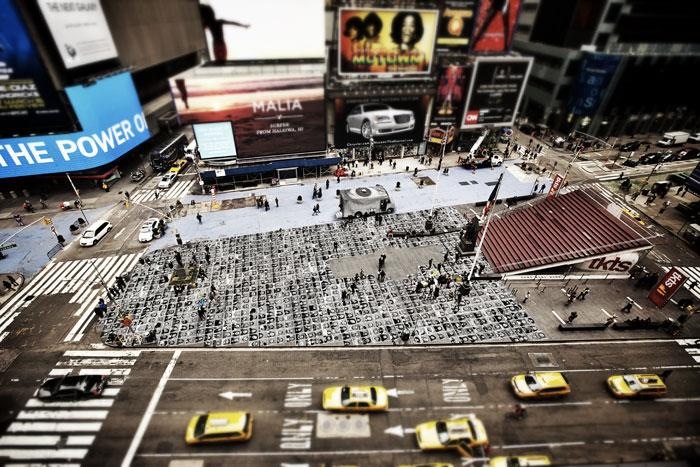
Inside Out New York in Times Square
As you can see, JR and his team are already making a large imprint on Times Square and other parts of the city with Inside Out New York. As usual, people flock to participate, and it's a wonderful sight to see.
The Inside Out Photo Booth Truck in Times Square
The Inside Out Project will have their photo booth truck set up at Times Square. Here's a photo of the truck (above), so you can spot it easily. The truck will either be parked on the corner of 47th/Broadway, or between 45th-47th Streets and Broadway, at Duffy Square, as seen above. Just look around the TKTS ticket booth area, and you should be able to spot the photo booth truck easily.
Learn How You can Participate in the Face of Dance Inside Out Project
Option #1 Photo Booth Truck in Times Square Face of Dance group portraits
Guaranteed 5-10 minute wait to have your photo taken for the Face of Dance Inside Out Project.
Our group will gather next to the photo booth truck at these times, so you don't have to go to the end of the line.
You are allowed to bring groups of people to help us represent DANCE in New York City.
Dawn Paap is organizing our Face of Dance Group, so look for her when you arrive so she can collect everyone's name and email for follow up.
NEW DATES:
Sunday, May 5th, 12:00 pm - 4:00 pm
Wednesday, May 8th, 12:00 pm - 4:00 pm
Individual Portraits
Go to the photo booth truck in Times Square on you own, and we can schedule a time to pick up your portrait to include it in the Face of Dance Inside Out Project.
If you go on your own, you will need to go to the end of the line. Wait time can extend to 2-3 hours. Getting there when they open may reduce this wait time significantly.
See the full schedule below for the Inside Out Project photo booth truck Thursday, May 2nd: 12:00-8:00 pm (Go on your own) for Individual Portraits Friday, May 3rd: CANCELLED (due to another event at Times Square) Saturday, May 4th: CANCELLED (due to another event at Times Square) Sunday, May 5th: 12:00 - 4:00 pm FACE OF DANCE GROUP (5-10 min. wait during these times) 4:00 - 8:00 pm (Go on your own) for Individual Portraits Monday, May 6th: 12:00 - 8:00 pm (Go on your own) for Individual Portraits Tuesday, May 7th: 12:00 - 8:00 pm (Go on your own) for Individual Portraits Wednesday, May 8th:
12:00 - 4:00 pm FACE OF DANCE GROUP (5-10 min. wait during these times) 4:00 - 8:00 pm (Go on your own) for Individual Portraits Thursday, May 9th: 12:00 - 8:00 pm (Go on your own) for Individual Portraits Friday, May 10th: 12:00 - 8:00 pm (Go on your own) for Individual Portraits Feel free to register here for option #1
JR working it in Times Square
Option # 2 Have Your Portrait taken at the NYC Dance Parade and Festival
Have your portrait taken for the Face of Dance Inside Out Project on Saturday, May 18th, at the annual Dance Parade and Festival.
Find us at the parade line up area on 21st and Broadway before the parade begins (11 am - 1 pm)
Find us in Tompkins Square Park during the Dance Festival (3 pm - 7 pm).
Feel free to walk up to us and ask to have your portrait taken for the Face of Dance
Email us to sign up to have your portrait taken before the parade begins, or afterwards at the Dance Festival.
If you need help locating us in Tompkins Square Park, go the the information booth (they'll know where we're at)
Option # 3 Schedule a Studio Shoot with us
Email us at thefaceofdance@gmail.com to discuss this option.
Answers to Questions Should you send us photos? No. We'll be taking all of the portraits for you, so we we're not seeking photos to be sent to us at this time. If that changes at all, we'll let you know. Besides, it's much more fun for you to come out and play! What's the news on displaying the Face of Dance portraits? We've had MANY offers to portray the portraits at different locations, which is fabulous! We couldn't be more exited! Because we'll be taking hundreds of portraits during these three events, we will need to organize all of the information and photos before we discuss placement options, as different venues can display them in different ways. Does everyone need to register before hand? No, but it would help us out if you did. If you're bringing a group, please email Dawn atthefaceofdance@gmail.comto let her know how many people to expect if you're bringing a group to the photo booth truck in Times Square. If you haven't had a chance to answer our brief questionnaire before you have your portrait taken, we'll email that to you later. Dawn will take down each person's name and email at the photo booth truck to follow up with participants as we move through the next phases of the project.
Need to know more about the Face of Dance Inside Out Project?
Choreography for
Audiences – Take One: Dance Film Review
By Dawn Paap and Leslie
Kilpatrick
On September 15, 2012 we joined a large group of
participants at the Irondale Theatre to welcome our chance to participate in a
live human game and choreographic/social experiment conceived and choreographed
by Noemie Lafrance as part of Brooklyn’s inaugural BEAT Festival.
Although there have been debates about film versus live
performance, Choreography for Audiences -Take Onechallenges these ideas by
delivering a blend of each to offer a unique experience for audience attendees. How often do audiences have an opportunity to
view a film’s creation on set or in real time?
Or step in to participate? Thankfully,
Sens Production invited in audiences to experience an interactive dance film
and work with internationally renowned choreographer Noemie Lafrance.
As part of an audience (or participants) adorned in outfits
of green, blue, black and tan, the check in line was a buzz of questions about
what we had studied in preparation for the games that await us. Prior to shooting the film, each team separated
to go over the instructions with Team Leaders regarding varied movement sequences,
and discovered how to strategize to earn points.
Blurring the lines between audience and performer, participants
were allowed to observe games being played and step in to be a part of the
action. Behind the scenes vantage points
offered a unique viewing experience for all involved…with chaos and unity
happening simultaneously…while achieving a one of a kind visual artwork. With a dozen geometrical shapes and patterns created
through human movement, chaos, and structure, Choreography for Audiences - Take
One allowed audiences to witness a live event like no other.
While taking part as spectators, we each quickly realized
the scientific dimensions of art we were viewing and experiencing.From mathematical patterns, to the social
experimental element, to the complexity of the choreography to include crowd
control and space, we witnessed LIVE art at another level.
The most challenging game seemed to be the ‘Fractal Box’
which relied on participants following a 2-4-6-8 unfolding pattern on grid lines
to create geometric patterns known as fractals.
With participants lining up to quickly move across the grid, while
needing to count steps to create the fractal shape and finish each mathematical
set before other teams, things got a bit messy at moments for each large group,
but were quickly corrected through a team effort.
With each of the games, we witnessed participants colliding
& instinctively adjusting around each other, testing Lafrance’s theories on
Kinesthesia within the context of this social experiment. Kinesthesia is defined as an acute human
sense that notifies the brain where the body is with reference to the matter
around it. It is the ability dancers
have to move in unison by perceiving their surrounding often assisting with
musical cues. Kinesthesia is often
referred to as a sixth sense because in 1557 Julius Caesar Scaliger originally
described the position-movement sensation as a “sense of locomotion” and later
called by Charles Bell “muscle sense”.
However, today scientists instead classify Kinesthesia as a combination
of external & internal sensations to and from the brain.
Learning theorists would also point out that having an
opportunity to view the games in play allowed participants to gain awareness
and be more able to maneuver their bodies to each game’s ending position with
fewer errors once they rejoined the action.
This is reflected in Noemie Lafrance’s Bodies as MediaHuffington Post article which
states: “By transmitting the content of the work to the audience, as if projecting
a film onto the audience’s body, we also transform the audience’s body into the
media. The audience’s body has the
choreography stored in it, waiting for activation and playback.”
We noticed that the longer the games continued, the more relaxed
each participant became with timing and execution, including being more in
tuned with one another, allowing observers to witness this transformation in
action. As individuals mastered each game,
the excitement about scoring points for one’s team and participation
intensified. At the end, no one seemed
ready to leave, and the audience side was mostly empty.
Lafrance’s mission to create art that is mass produced within
a social experimental structure is as brilliant as it is ambitious. Social experiments are important educational
tools for all cultures, as seen by decades of literature among the collective social
sciences. What can this documented
experience lead us to discover about one’s ability to read another’s presence, participate
in competition, and master game play? What
will this dance film offer in terms of inspiring future research on dance?
Noemie Lafrance’s vision as a choreographer is unique in its
regard to audience involvement in her works, and offers much to the shared
experience of dance for everyone. With her
interdisciplinary approach of combining art, science, and technology for Choreography
for Audiences - Take One, she offers an innovative look into performance
language and challenges how choreographers traditionally communicate with
audiences.
Taking audience communication even one step further, Sens
Production is sharing copies of the film with each participant, allowing individuals
to share their creative experience with broader audiences through the ease of
social media sharing platforms. We’d
like to extend our appreciation to Noemie Lafrance and Sens Production for
inviting us to partake in Choreography for Audiences - Take One. We look
forward to seeing the director’s final edit of the dance film and sharing it with
others.
In conclusion, we’d like to
officially give this dance film a rating of “Two Thumbs up” from the Blue Team!
This week Video Dance TV celebrates artists love for New
York City with the DANCE FILM SERIES: “Solo with New York”. Each videodance below reflects, embodies, and
subverts the dynamic interaction between an individual’s movement style and her
environment.
Enjoy the work of Nejla Yatkin as she explores different locations that are
uniquely New York and which illustrate her love of the city.
Solo with New York: “View from my Balcony”
Solo with New York: “Central Park”
Solo with New York:“Times Square”
Solo with New York:“Wall Street Bull”
Solo with New York:“View from Long Island”
Tune in for the DANCE VIDEO OF THE DAY for more short films and videos which tell stories of New York City and various artists who celebrate their city through movement.
Choreographer Elizabeth Streb
unleashed her daredevil dancers around the city of London in a one-off Olympics-inspired project with a day of surprise performances across London's iconic
landmarks.
At rehearsals for her new Olympics-inspired project, One Extraordinary Day Streb explains why one day took a whole year to plan.
Whether it's asking dancers to bungee jump 40ft drops or dangling them off buildings, few people have pushed the human body to the limits like American choreographer Elizabeth Streb. Known for her extreme dance and book How to Become an Extreme Action
Hero, she has previously staged events at New York's Lincoln Center and Grand
Central Station.
For one day only, visionary New York choreographer Elizabeth Streb and her team of dancers staged a visually stunning feat in a series of performances for One Extraordinary Day around London's famous monuments - from the Millennium Bridge to Trafalgar Square to the awe inspiring finale on the London Eye.
In the video below, the dancers can be seen walking down City Hall, performing
'Sky Walk'
Commissioned by the mayor and the London 2012 festival, the event was billed as a 'performance of power, daring and beauty that will totally disarm those lucky enough to see it'.
A video by Crane.tvcaptures the action as it happened, and finds out from Streb how she plans to make Londoners feel differently about their city.
Check out Video Dance TV on Twitter, Tumblr, and YouTube, to view more videos which celebrate the Olympic Games in London, including the DANCE FILM series 'Postcards From East London' by Artistic Director Jo Parks.
The Hooping Life
interweaves the stories of eight performers, activists, teachers, and healers
as they take a mere kid’s toy, the hula hoop, and with pure grit and
determination, reinvent “hooping”
into a dance, a spiritual practice, and a fitness phenomenon.
Footage filmed by the hoopers themselves was
included in The Hooping Life, giving a raw
authenticity to their personal stories of transformation. This
picture is vibrant, edgy, and truly resonates on a multi-cultural level while
giving an eye-opening look at an infectious and beautiful new cultural
movement.
The Hooping Life chronicles the birth of subculture that
forms a supportive community, while these individual stories of transformation offer a unique platform forconversations about
important community issues:
Self-Discovery: Anah/Hoopalicious is
directionless in Hollywood, and struggling to find her purpose.
Entrepreneurship: Overweight and
introverted, Christabel pursues liberation, weight loss, and a career as a
successful entrepreneur in San Francisco.
Mental Health: Baxter overcomes
suicidal depression by hooping blindfolded and defines a new form of
spirituality.
Gangs/Violence: Tisha and her
student Jeffrey create an after school safe haven of hooping for kids in the
gang-laden neighborhood of South Central LA.
LGBT Issues/Bullying: Bullied as a
teenager for being gay, Karis takes on issues of gender and sexual identity
with gender-bending hoop performances worldwide.
Rape Crisis: Sass reclaims her
body and life after a brutal home invasion and rape in South Africa.
Entertainment: Stefan and his NYC
dance troupe surprise the urban rat race and landscape with play in unexpected
places.
The film will be opening on May 4th at the following cinemas:
IFC Center - New York, NY
Elinor Bunin Munroe Film Center - New York, NY
For the young dancers at the Youth America
Grand Prix, one of the world's most prestigious ballet competitions, lifelong
dreams are at stake. With hundreds competing for a handful of elite
scholarships and contracts, practice and discipline are paramount, and nothing
short of perfection is expected.
Bess Kargman's award-winning documentary,
FIRST POSITION, follows six young dancers as they prepare for a chance to enter
the world of professional ballet, struggling through bloodied feet, near
exhaustion and debilitating injuries all while navigating the drama of
adolescence. A showcase of awe-inspiring talent, tenacity and passion, FIRST
POSITION paints a thrilling and moving portrait of the most gifted young ballet
stars of tomorrow.
View the Film Trailer Below
Director Bess Kargman
My entire childhood I
danced. I always had this huge love of ballet, despite my early “retirement” at
the age of 14. Fourteen years later, when I took a break from journalism and
set out to direct my first feature film, I decided to make a movie that I
always wished had existed. And then I got lucky: One day I was walking in lower
Manhattan and saw a pack of ballet dancers waiting to get into the final round
of the Youth America Grand Prix competition, held annually each spring. It was
sold out so I snuck in and sat in the back. On stage walked an 11-year-old girl
(“bitty baby ballerina,” I called her), whose 2-minute performance had such
artistry, grace, and strength that I stood up, walked out of the theater and
said, “This Is My Movie.” What unfolded next was a thrilling (and sometimes
exhausting) year of fundraising and shooting, and then nearly a year of
editing. I knew I wanted to show how diverse the ballet world is in terms of socio-economic
status, race, and geography. Additionally, I wanted to shatter stereotypes (not
all skinny ballerinas are anorexic, not all male ballet dancers are gay, not
all stage mothers are psycho, and so on). I also wanted to show that a
competition that awards scholarships to elite ballet schools can pave the way
to making it as a dancer, but that the steep climb to get there is daunting, as
ballet training is extremely expensive and injuries often ruin careers. Most
importantly, I wanted to show that the level of devotion (and amount of
training) required to succeed as a dancer is no different from any other
professional sport.
I’m thrilled to finally
have that opportunity and grateful to the talented people (both behind and in
front of the camera) who gave it their all to see FIRST POSITION turn into the
movie I always wished had existed.
A scene from FIRST POSITION
Q&A
with Bess Kargman
What do you want
audiences to learn from FIRST POSITION?
I think there is a lot of misconception about the ballet world, so I made
sure to select subjects that I knew would be able to challenge certain stereotypes.
I wanted to show that not all ballet dancers are rich, not all are white, not
all male ballet dancers are gay, not all female ballet dancers are anorexic,
and not all stage moms are psycho…etc.
Also, few people realize the toll that ballet takes on the body (or that the
pain threshold of professional dancers is close to superhuman). I knew that if
I could thoroughly document the worlds these dancers inhabit, and the
challenges they face on a daily basis, I would be able to craft an extremely
unique documentary.
A behind the scenes look at FIRST POSITION
What prompted the idea
for your film and how did it evolve?
My entire childhood I danced. I always had this huge love of ballet (even
after quitting to play ice hockey). There are two things that compelled me to
direct and produce FIRST POSITION.
I believed that my ballet background was
enough of an asset to help me overcome some of the mistakes that I feared
making as a first-time director. Secondly, growing up this was a film I wished
had existed (or to put it more selfishly, I was tired of waiting for someone
else to make the movie).
There were a slew of veteran filmmakers who (in an effort to provide well-intentioned
advice) told me I was biting off more than I could chew. They reminded me how
few documentaries are released theatrically each year, and how much work is
required to distill hundreds of hours of footage into a 90-minute feature.
These are things I never forgot along the way, but I forced myself to pretend
otherwise. Maintaining such an outlook helped me stay focused (and optimistic)
during the two years it took to shoot and edit the film.
Jules Jarvis Fogarty in FIRST POSITION
Elaborate
a bit on your approach to making the film.
The
two most important things that I learned as a student at Columbia Graduate
School of Journalism are that a story is only as good as its characters, and
that access is everything. These principles hold true no matter what format the
story is told (whether it be print, radio or on film).
I
knew I would have to convince the competition to grant me exclusive access, and
so I put together a detailed proposal that outlined my desire to create an
honest portrayal of what it means to have a dream at such a young age, and the
sacrifice required to make it as a dancer. I also knew that for some youths
(especially in this economic climate), winning a scholarship can mean the
difference between making it as a dancer or relinquishing a dream.
Lastly,
I feared that if I solely relied on outcome (who wins) I would be risking the
entire project on factors I had no control over. So I selected subjects whose
personal stories were so compelling that even if everyone tanked, the audience
would still leave the theater feeling moved and inspired by a group of
extraordinary dancers who, at such a young age, have devoted their lives to
ballet.
ABOUT THE CAST
Miko Fogarty
Miko Fogarty was born in London, England in 1997 and
trains with Viktor Kabaniaev in the Professional Program at
the Westlake School for Performing Arts in San Francisco, USA. She
currently lives in Orinda, California near San Francisco with her brother
Jules, her mother Satoko, and her father Mat.
During the filming, she was training at the Diablo Apprentice Program. From as long as she can remember, she has
always aspired to become a professional ballerina. In the summers of 2008, 2009
and 2010, Miko trained at the Royal Ballet School’s International Summer
Program in London and was selected to dance solos in the final performances and
received the Commendation Award each year. In 2009 and 2011, Miko won the Gold
Medal at the World Ballet Competition in Florida. In 2010, she won the
Bronze Medal at the New York Finals of the Youth America Grand Prix. In 2011,
Miko was invited to perform on the “YAGP’s 2011 Ballet Grand Prix Tour” and
danced with accomplished artists: Jose Manuel Carreno, Igor Kolb, Elisa
Carrillo Cabrera, Mikhail Kaniskin, Oksana Skorik, Drew Jacoby and Rubinald
Pronk. Miko was featured in the ballet documentary "First Position",
which won multiple prizes at film festivals. “First Position” will be in
movie theaters internationally in the Spring of 2012. Since 2009 (age 12), she
has been doing online school to give her more time to dedicate to ballet. This
allows her to dance 4 to 5 hours a day and also travel for competitions and
tours. Miko was listed as one of “The Most Influential People of 2011” in the
Dance Spirit Magazine.
Jules Fogarty
Jules Fogarty was born in London, UK in March 1999. His father is
English and his mother Japanese. When Jules was 5 months old, he moved to
California and started ballet when he was 4 years old. It was a lot of
fun when he was a little kid as it was good to be with his friends, acting, and
jumping around.
When Jules was 9, he did his first YAGP and won first place in the
regional and the bronze medal in the New York finals. The following year he did
YAGP again (as shown in First Position) but did not win. Some day he hopes
to be an entrepreneur like his father.
Joan Sebastian Zamora
Strong and serious, Joan Sebastian, 16, has left his mountainside village
near Cali, Colombia for a brighter future in America. His mother, who describes
herself as a former frustrated ballerina, is his greatest source of
encouragement. Every time he calls home he is reminded of the sacrifices his
family has made on his behalf, and their high expectations of him to help
support them in the future. Joan Sebastian's dream is to dance for the Royal
Ballet in London, England, where his inspiration, the Cuban star Carlos Acosta,
dances. If he wins a Youth America Grand Prix scholarship to train at the Royal
Ballet School, he is one step closer to achieving this dream.
Aran Bell
Aran Bell, who is
eleven years old in the film, began his training at age four in Bremerton, Washington
with Michiko Black and continued training at Central Pennsylvania Youth Ballet.
Originally from Washington, his family relocated to a US Navy base in Naples,
Italy after his father, a military doctor, returned from a tour of duty in
Kuwait. In 2009, Aran began studying with Denys Ganio in Rome, Italy. He has
also attended the Royal Ballet School, and American Ballet Theatre summer
programs. Aran was the winner of the Hope Award at the Youth America Grand Prix
Finals in 2009 and 2010. In 2010, he was also the Grand Prix winner of the
Milan International Ballet Competition. He was awarded the Junior Grand Prix at
the 2011 YAGP Finals, and the gold medal at the Rieti (Italy) International
ballet competition. Aran has performed in numerous galas in Italy, France,
Germany, England, Austria, Poland, Romania, and several U.S. cities. Today,
Aran is home schooled in order to spend 2 hours a day commuting to his dance
school in Rome, where he trains for five hours a day. Aran’s hobbies include
skateboarding, snowboarding, playing with action figures and collecting toy
guns.
Michaela DePrince
A war orphan from Sierra Leone, Michaela DePrince was adopted by a large
American family in New Jersey when she was four years old. At that time her
only exposure to ballet was from a crushed and smudged magazine photo that she
found clinging to the gates of the orphanage. Michaela begged her new American
mother for dance lessons, and soon she was studying ballet, modern, tap dancing
and jazz at Dalia Hay’s Dance Academy in Cherry Hill, New Jersey. She also
studied ballet for seven years at The Rock School for Dance Education, where
she continued her interest in modern, jazz and tap dancing. While at The Rock
School, Michaela won both the Hope Award and the Junior Grand Prix at the
Philadelphia Regional Youth American Grand Prix. From age eleven to thirteen,
Michaela studied ballet in Northern Vermont, from Vanina Wilson, a French dance
trained in the Paris Opera Ballet, Alain Albertson Murphy, a former principal
dancer in the San Francisco Ballet and Alex Nagiba, a former soloist of the
Pittsburgh Ballet Theatre. During that period of her childhood, Michaela also
had the good fortune to study with two legends of the ballet world, Monsieur
Daniel Seillier in Montreal and Mr. Arthur Mitchell at the Dance Theatre of
Harlem’s Summer Intensive. She first attended the American Ballet Theatre’s
Summer Intensive in New York City when she was thirteen. Michaela was named a
National Training Scholar at the end of that summer. She was a participant in
the 2010 International Ballet Competition in Jackson, but it was through the
Youth American Grand Prix, where she was an annual finalist for five years,
that Michaela was first awarded a scholarship to The Jacqueline Kennedy Onassis
School of the American Ballet Theatre. Last year she felt honored to be awarded
The Beverly G. Smith Scholarship. This year Michaela is doubly honored to
receive this scholarship again.
ABOUT THE CREW
Bess Kargman
(Director/Producer/Editor)
Bess has crafted timely, socially and politically relevant stories for
numerous media outlets including National Public Radio, The Washington Post and
a variety of online publications. She holds degrees from Columbia Graduate
School of Journalism and Amherst College. Long before entering the world of
film and radio, Bess trained at Boston Ballet School (until she was recruited
to play varsity ice hockey). FIRST POSITION is her first film, and premiered at
the 2011 Toronto International Film Festival (where it took People’s Choice
runner-up for best documentary). When she’s not living out of a suitcase,
Kargman divides her time between New York and Los Angeles.
Nick Higgins (Director
of Photography/Associate Producer)
Nick has shot documentaries for such award-winning directors as Lucy
Walker, Morgan Spurlock and Stuart Sender. Currently he is shooting new
projects for National Geographic and PBS. Nick has spent most of his life
living everywhere except his Scottish birthplace; most notably Saudi Arabia,
Hong Kong, Brazil and now Los Angeles. Along the way he picked up Portuguese,
earned a Masters in Cinematography from AFI and became a father.
Rose Caiola (Executive
Producer)
With a love of ballet since childhood, Rose Caiola is now the Founder and
Executive Artistic Director of the Manhattan Movement and Arts Center (MMAC)
and the Manhattan Youth Ballet. Caiola is also a Broadway producer and the
co-author and producer of the new musical Freckleface
Strawberry. Caiola’s goal throughout all her projects has been to
provide equal educational, cultural and artistic opportunities for inner city
youth. She is a graduate of NYU’s Tisch School of the Arts and is a member of
The Broadway League of Theatres and Producers, and the Screen Actors Guild.
Chris Hajian (Composer)
Born and raised in Queens, New York, Chris’ formal musical training
started at the “Famed” High School of
the Performing Arts, and continued at the Manhattan School of Music, where he
studied classical composition. He has created scores for a wide range of narrative
films, indies and documentaries, including “The Take” (2007), “Nursery
University” (2008) and “Unraveled” (2011), which had its US premiere at the LA
Film Festival and will have its TV broadcast premiere on Showtime.
Kate Amend (Editor)
Kate’s editing work includes two Academy Award-winning documentaries: The Long Way Home and Into The Arms of Strangers (for which
she won an American Cinema Editor's Eddie award). Her many other credits
include Thin (HBO)and
The World According To Sesame Street (both of which premiered at the 2006
Sundance Film Festival). She is an advisor at the Sundance Institute
Documentary Edit and Story Lab and is a faculty member of the Cinema Department
at USC.
Jennilyn Merten
(Associate Producer)
Before working on First Position, Jennilyn
co-directed the documentary Sons of
Perdition, which premiered at the 2010 Tribeca Film Festival and was bought
by Oprah Winfrey for her Documentary Film Club. A partner in Left Turn Films,
she has also directed, produced, and edited numerous commercial projects for
corporate clients.